| | Biker News - Regularly updated
Category: Tourism & Travel
-
A ground-breaking new survey has shown a staggering increase in the number of men experiencing symptoms traditionally associated with a mid-life crisis, including significant numbers of young men. The study also highlights that these men are still turning to the ‘classic techniques’ used for coping at such a time.
The study was commissioned by Bennetts, the UK’s No.1 Bike Insurance Specialist, to understand whether the belief that men between 40 and 55 years old buy a motorbike to cope with a mid-life crisis, remains true or not.
The research amongst over 1,000 British men* showed that six out of every ten men aged between 40 and 55, the age traditionally most associated with the mid-life crisis, now say they have had or are currently experiencing a mid-life crisis. Responses showed that those men find it difficult to understand and hard to handle, with friends and family being confused and showing limited support.
These symptoms, however, are no longer reserved for this age group. The majority of men between 16 and 70 years old now report a life-review or transition experiences with nearly three quarters (73%) currently being or having recently been concerned with the direction of their life. Interestingly, more young men have recently asked themselves “where am I going with my life?” “what are my goals?” and “should I take more risks?” than those aged between 40 and 55.
Perhaps most strikingly the research by Bennetts reveals that, while more men are experiencing a mid-life crisis and at different ages, classic techniques for coping are still as popular as ever. Buying a car or motorbike still tops the list alongside changing job, moving house and forming a new relationship.
In fact, a third (30%) of motorcycle owners who are going through or have been through a mid-life crisis got into bikes specifically to cope. Bikers come out of the study exceptionally well, reporting the greatest success in managing their mid-life crisis adaptively, rather than being in denial. Over half felt they had dealt with their mid-life crisis positively, the top response.
Only 13% of the bikers said they had not yet overcome their mid-life crisis and they reported the fewest ‘changed relationships’ and the most ‘involved partners’, signifying that they maintained better relationships with their partners compared to men adopting different coping mechanisms.
Bennetts’ customer data shows that sports bikes are currently the biggest purchase of choice among men from the ages of 16 to 54, whilst from 55 upwards the roadster – a more relaxed and comfortable bike to cruise on - appears to become a more popular buy.
Speaking about the research findings, Dr Derek Milne, author of ‘Coping with a Mid-Life Crisis’, commented: “These findings suggest that British men are struggling more than ever to cope with modern life. I find it heartening that bikers, often portrayed as somewhat solitary and anti-social, seemed to become more sociable through biking, helping them to deal with their mid-life crises.”
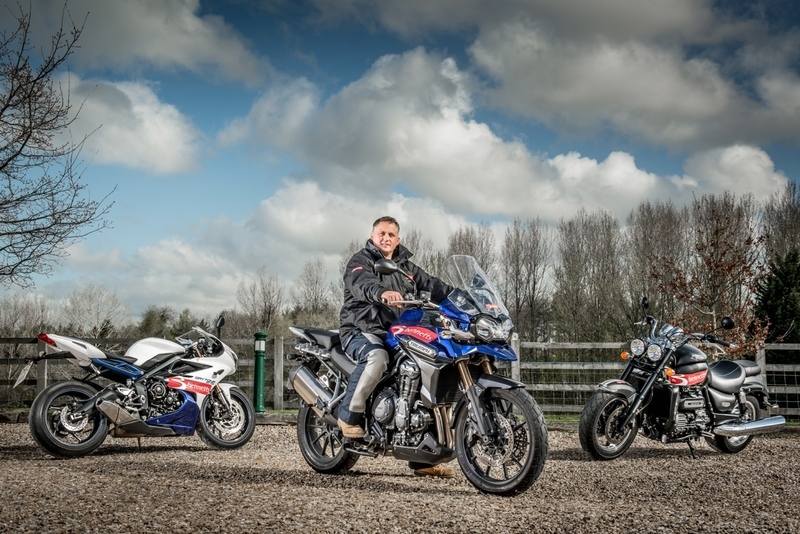 Darren Gough, the England cricket legend and Bennetts biking ambassador, who turned to motorcycling after retiring from first-class cricket in his mid-thirties, said: “You often hear about sports players finding it tough to call it a day. Finding something to replace the kick you get by taking a wicket and playing to a packed Lord’s is not easy. Learning to ride and buying an adventure motorbike was exciting as is the rush of freedom you get when hitting the open road for a few hours.” Darren Gough, the England cricket legend and Bennetts biking ambassador, who turned to motorcycling after retiring from first-class cricket in his mid-thirties, said: “You often hear about sports players finding it tough to call it a day. Finding something to replace the kick you get by taking a wicket and playing to a packed Lord’s is not easy. Learning to ride and buying an adventure motorbike was exciting as is the rush of freedom you get when hitting the open road for a few hours.”
Hannah Squirrell, Associate Director, Bennetts, added: “I suspect a lot of men who dream about owning a motorcycle will be pleased to see motorbiking up there on the list of ways to deal with a mid-life crisis. If your partner questions whether you should be investing in a new bike, ‘saving or improving your relationship’ is a pretty strong reason to justify the expense!”
For more information about Bennetts, go to www.bennetts.co.uk
* The research by Bennetts was carried out online by Opinion Matters between the 5th and 14th June, 2013 amongst a panel resulting in 1,001 men aged between 16 and 70.
-
Converts take to social media to share their enthusiasm
Facebook is buzzing with comments and pictures from the 400 people who had their first taste of dirt riding over the weekend.
The four day long Motorcycle Off-Road Experience was held between 13th - 16th June at Brake Hill Farm in Brigstock, near Ketting. It was organised by the members of the Motorcycle Industry Association’s off-road group, to provide people with the opportunity to try off-road riding for the first time.
This attracted people from 38 different counties plus London. Some were road riders, but quite a few had never been on a bike before. Despite this, most managed to progress to a full motocross trail by the end of each session, with the help of expert trainers, including 3 times World Champion Dave Thorpe.
Honda, Kawasaki, KTM, Suzuki and Yamaha provided bikes, kit and trainers for a heavily subsidised fee of just £15. The AMCA ran the trackside element of the event with overall project management and communication provided by the MCI. Other off-road organisations also attended to provide a comprehensive induction into all off-road options. These included the sporting body ACU and the Trail Riders Fellowship (TRF), which works to preserve the use of green lanes and offers a gentler form of recreation for motorcycle off-roaders.
The weather was windy but mostly dry and with so many people turning up early for sessions, it was easy to bring the start time forward one day when rain threatened.
The MCI contact centre managed the registration and booking process and is in the process of surveying all participants to see how they will be pursuing their interest in off-road riding. 93% agreed to be contacted by manufacturers and trainers post event.
Howard Dale, General Manager of Kawasaki and Chair of the MCI’s Off-Road Group says the response was incredibly positive: “I’ve never seen so many happy faces in one place. People were buzzing after their first taste of off-road riding. It was the same among all those involved in running the event too. This level of cooperation within the industry is unprecedented, and the ‘feel-good factor’ for everyone involved over the past four days has gone off the scale and importantly many of those attended are determined to pursue further training or buy a bike!”.
Comments from facebook:
-
Our contact in Shanghai was Roger Owens, or Junior as he was called back in the days when he was the youngest member of the Northern Ireland volleyball team I captained at the Commonwealth championships in 1981. Or was it 1881? I can never remember.
Now a successful businessman, he’d sent his company’s bright blue London taxi to meet us at the airport. As it hurtled along the superhighway from the airport into Shanghai, it was like entering the set of Bladerunner on drugs, with the rivers of headlights and tail lights streaming constantly between some of the most exquisitely designed skyscrapers on earth. And yet, as we turned into the street where our hotel was, there was a tiny bicycle repair shop on the corner, with an old man squatting on the floor fixing a puncture, just as in Clancy’s day.
Next day, it was out on the Clancy trail with our guide, Kent Kedl, boss of a company called Control Risks who specialised in fraud investigation, kidnapping management and hostage negotiation. “Kent, with a name like that, you’ve got to be either a Californian surf dude or one of Superman's mates,” I said as we walked off a main street straight into the heart of old Shanghai, its narrow streets pungent with the aromatic smoke of assorted creatures being fried, boiled or roasted and noisy with the clack of old men playing mah jong and traders advertising their wares.
In narrow windows hung bolts of silk, wool and cashmere which tailors would transform into fine suits and shirts in a matter of days for a song, while the cobbler next door would furnish you with a pair of bespoke handmade shoes in only a few days more. The Confucius Temple Clancy described is still there, past a pond crossed by a zig-zag bridge so that ghosts can’t find their way to the Starbucks opposite and are forced instead to queue for a pricey tea ceremony, although I doubt if Bill Clinton and the Queen coughed up a fiver for a cuppa when they visited. And beyond, the Yu Gardens are exactly as Clancy found them: a haven of goldfish ponds, elegant trees, bamboo groves, cobbled walkways and temples for calligraphy, meditation or prayer.
As we emerged, Gary spotted a stall selling Mao hats and badges, and a white Chinese fighter pilot’s helmet with a red star on the front for which the stallholder was asking 320 yuan, or about £32. “How much should I offer her?” he asked Kent. “Same tactics as hostage negotiation. Offer her 30 per cent, then walk away,” laughed Kent. He was right, of course, and two minutes later, Gary walked away 12 quid lighter and a helmet richer. “If you need a jet to go with that, I know a good arms dealer,” said Kent.
The next day, having seen what Clancy saw, we met Roger for the tour of what he hadn’t, taking the ferry across the river into another world, of wide boulevards and 3,000 skyscrapers, more than New York, with another 2,000 planned. At the end of the day, we toasted Clancy in the Long Bar of the Peace Hotel, where Douglas Fairbanks and Charlie Chaplin once dallied. In the corner, the hotel’s legendary jazz band played just as they had as young men before the Communists disbanded them after the Revolution in 1949.
With the city now buzzing again, they had been hauled out, dusted off and told they could start playing their decadent capitalist tunes again, even though they were now all in their eighties.
The next day, we were on the plane to Nagasaki, where as the Bulow docked in 1913, Clancy almost certainly grinned with pleasure to see, as his Henderson was lowered onto the dockside, a sight he had not seen for some time: roads. As he motored north, around him was a country more delightful, beautiful, peculiar and above all different to anything he had ever seen, particularly the quaint habit of locals to dash out of their homes and into the road when they heard his horn, thinking it meant the arrival of the fried fish salesman, the pipe cleaner or the clog mender.
Still, apart from kamikaze pedestrians, rickshaws and carts, he had the roads to himself, since he saw no motorcycles and only a single car in his whole time in Japan. It is, as you can imagine, much the same today. We had arrived in Nagasaki just too late for cherry blossom season, that time of year when the petals come fluttering down to remind the Japanese of the fragile, temporary beauty of life. But then, the city where we stepped ashore became an even greater reminder of that on the morning of August 9, 1945, when the 240,000 citizens woke to a warm but overcast day and were glad when the clouds parted at 11am to reveal just enough blue sky to make a sailor suit. They shouldn’t have been, because at that moment the crew of the B-29 Superfortress Bockscar returning from finding Kokura, their planned target, obscured by cloud, saw Nagasaki through the same gap and dropped their bomb on it from 30,000ft.
In three seconds, 70,000 people died and another 70,000 were fatally poisoned by radiation. We emerged into glorious sunshine and bought two cones from an old ice cream seller, and in a few deft scoops she created what looked like two perfect roses almost too beautiful to eat. She handed them to us with a polite bow, and in that moment I was reminded again why I love Japan, for the infinitely loving care given to the beauty of detail in everything from bathing and the tying of a kimono to the tea ceremony.
And so, with world peace in the balance but my love for Japan secure, I returned to our traditional ryokan and a struggle with the four thousand buttons on the slightly less traditional automated toilet. At one stage I accidentally cranked the heated seat and hot air bottom drying fan up to maximum heat, leading to a few seconds of intense panic that my nether regions would burst into flames and I would be charged with arson.
-
It seems the wearing of compulsory Fluorescent/Yellow HI Viz/Jacket/Vest by French bikers while riding has gone away for now.
France’s National Road Safety Council requests that the new road safety recommendations to be translated into regulatory text by the Government. The recommendation from the council is similar to that which is obligatory for motorists, which would be to carry a high visibility vest under the motorcycle seat, in a bag, in the box top etc and for that vest to be worn in case of an emergency stop. We cannot leave the article without mentioning our previous reporting on the Hi-Viz issue which spilt across the channel into the UK.
That is to state that the Hi-Viz issue was not a European Union issue, there was no European proposal, it was a national French issue and there were no plans by the UK or Northern Ireland Governments or agencies to introduce Hi-Viz here.
Although we have said that this is a French National issue it is worth keeping an eye on the issue as riders from the UK need to be kept informed for trips across the channel.
For now at least, the wearing of a yellow vest while riding a motorcycle in France is not mandatory.
Read the full article on Right To Ride EU
-
Recreating the first around the world ride 100 years on...
At the border crossing between France and Spain at Le Perthus, Clancy ran into trouble. “A villainous Spaniard, bedecked in the most dressy of uniforms, blocked my entrance into sunny Spain,” he fumed in his diary that night.
This “veritable brigand” then charged him a whopping $55 customs deposit, or almost a month’s wages back home, in import duty, then had the audacity to demand a tip. Giving him six cents, Clancy set off into Spain, only to be slowed to 15 miles an hour by the dreadful roads. “To all those who are planning to motorcycle in Spain, let me give one word of advice – don’t!” he wrote grimly. Then, a broken crankshaft bearing forced him to spend the night in Figueras, where his complete lack of Spanish led to him being led to a hotel with half the town at his heels when he asked for a garage, and the waiter bringing him a bottle of wine in his hotel that night when he asked for the bill.
Today, Le Perthus is a long, steep street lined with shops, off-licences and tattoo parlours, its pavements hiving with shoppers carting crates of cheap booze back to France, the entire scene watched over by a disturbingly glamorous blonde policewoman. “I wonder how I could get myself arrested and strip-searched,” said Gary as we looked in wonder at a scene in which the only thing Clancy would have recognized is the ancient customs post at the bottom of the street. Leaving the Henderson in Figueras to be repaired, Clancy boarded a “wretched hencoop train” which took seven hours to get to Barcelona, during which he decided that he preferred the Spanish to the French both in looks and temperament and they were “even more gay than the Italians in nature”.
Ah, how the language changes. If we’d told any of the Spaniards we met that they were more gay than the Italians, a riot may well have ensued. Wandering around Barcelona the next day, Clancy felt refreshed by the constant laughter and play of children, and deeply impressed by the fact that the hard dirt streets were swept and sprinkled with water every night. Most enchanting of all, though, was the paseo, or evening walk, in which the citizens strolled hand in hand or arm in arm. He would be pleased to know that both the paseo and the sprinkling of streets are customs maintained to this day, and although the children he saw laughing have grown up and old and died, their grandchildren are laughing still.
He went to bed a happy man, then took the train back to Figueras to see how the repairs to his Henderson were coming on, only for an “exasperatingly slow mechanic and his two ornamental assistants” to take three days for the job, leaving him with only 24 hours to ride the 120 miles back to Barcelona port for the boat to Algiers. He set off at 5.30 on wretched roads which shook him to a pulp, and by the time darkness fell at nine, he had only covered 60 miles. The fact that he could not even see the holes and rocks in the road added to his misery, and after an hour in which he saw neither a living soul nor a house, he fell twice, the first time smashing his light and the second almost breaking his leg. He pressed on into the night, pushing the bike across countless fords and rivers, until his nerve was badly shaken when the shadows at the bottom of a steep descent suddenly turned out to be a raging torrent. “After a while I got so I didn’t care – philosophically reflecting that one must die sometime and to die with one’s boots on is very noble; so I rushed all the fords that came later, and surprised myself each time by reaching the other side alive. My dear old Henderson seemed to enjoy the excitement,” he wrote in his diary.
I wonder what he would made of the eight-lane motorway along which we sped at 80mph to Barcelona, since we had a hot date at the statue of Christopher Columbus in Mirador de Colom with Adelaide director Sam Geddis and his wife Gloria. It was an appropriate choice, not only because Columbus was an adventurer, but because we were being watched over by the ghost of Clancy, since he’d stayed in a two-room apartment overlooking this very spot.
In the previous Adelaide Adventure around Oz, Sam and Gloria had flown out to ride with us for the first three weeks, and this time around they’d planned to do the same, after Sam had gone to some trouble persuading his fellow directors that Adelaide should sponsor this to a degree which they were reluctant to do in the middle of a recession. Then, when Triumph, the original providers of bikes, had to pull out because of a black hole in the sponsorship funds which they couldn’t fill, it was Sam’s suggestion to go to Jim Hill at BMW Motorrad Mallusk, a good friend of BMW’s UK head of marketing, Tony Jakeman.
Although work commitments ended up scuppering his original plan of riding with us through Europe, he and Gloria had come out to join us for a day in Barcelona, and there they were at the Columbus statue, Gloria looking immaculate as ever, since on the Oz trip she’d managed, by my reckoning, to fit 4,386 changes of clothing into a single suitcase. “Geoff, great to see you. Fancy a Magnum?” she said. That’s right, I’d forgotten: one of the rituals in the baking heat of Oz was the daily stop for a Magnum, possibly the finest ice cream bar on the planet. “Gloria, are you mad?” I said. “I’ve seen enough ice in the past fortnight to last me a lifetime. Nonsense. It’s a lovely day,” she said, nipping off and returning with Magnums for all. After all the photos were done, I took Gary on a motorcycling tour of the sights of the city: the Sagrada Familia, Casa Batllo and Parc Guell. That night, we all met up again for a slap-up meal in Los Caracoles, an ancient restaurant in the old quarter, and after the usual argument, Sam ended up picking up the bill, as he does.
And so, fed and watered, we sped south through Italy, heading for Tunisia to see if we could blag our way into Algeria at the border.
Follow the blogs on www.adelaideadventures.com
|