| | Biker News - Regularly updated
Category: Other
-
Two of the UK’s leading motorcycle accident law firms have joined forces to provide specialist cross-border legal expertise to motorcyclists injured in road traffic collisions in Scotland and the North of England.
The strategic alliance between Motorcycle Law Scotland in Scotland and Hipkin & Co Solicitors based in North East England unites the market leaders in motorcycle accident representation and will see each firm refer clients when an accident happens in the other’s jurisdiction and where a different legal system exists.
If a motorcyclist has an accident in Scotland but lives in England, their claim is subject to Scottish law and they therefore need to use the services of a Scottish firm. Likewise, if a Scottish motorcyclist has an accident in England, then they need to use a firm based in England or Wales as any claim is subject to the legal system of England and Wales.
Brenda Mitchell, founder of Motorcycle Law Scotland with more than 25 years of experience as a personal injury lawyer, said: “By working together, both Motorcycle Law Scotland and Hipkin & Co Solicitors will ensure that cross-border clients will receive the best possible representation when claiming for often very serious injuries sustained in motorcycle accidents. So often these accidents need specialist knowledge and handling, and this will ensure our clients always receive the highest standard of advice.”
The alliance also aims to highlight the need to instruct independent, specialist motorcycle accident lawyers to fight a victim’s claim, rather than accept a solicitor ‘appointed’ by an insurer.
When a motorcyclist is involved in a road traffic collision as a result of a driver’s negligence, they are entitled to claim for their loss, injury and damage. In these circumstances, the choice of legal representation is up to the motorcyclist and not his or her insurer. However, because of the unique nature of motorcycle accidents, it is best to instruct an independent specialist motorcycle accident lawyer who understands motorcycling, rather than one “appointed” by an insurer.
Mark Hipkin, Principal and head of Hipkin & Co Solicitors motorcycle department added: “Brenda and I have known each other for over 10 years. We share a common interest in bikes, biking and putting our biker clients first. Both of us go the extra mile for our clients and it’s our personal service and “never say die” attitude that gets us results. Our alliance is a natural step to helping bikers on both sides of the border – which is only 70 miles away from our office. I regularly enjoy the tremendous roads that Northumberland and the Borders offer bikers.
-
A 51-year-old cyclist was killed on a charity bike ride after riding over a pothole the council had failed to repair, an inquest heard.
Martyn Uzzell died instantly when he hit the 4in deep pothole on a main road and was thrown into the path of a car. Only a month before the tragedy, the council sent workers to inspect the pothole after police said it was a hazard. But it was decided immediate repairs were not necessary.
Coroner Rob Turnbull told the inquest at Skipton Magistrates’ Court there was ‘no doubt whatsoever that the condition of the road on that occasion was the cause of the incident’. He said the pothole, which surrounded a roadside drain, had ‘existed for some time prior to the accident’.
Yesterday Mr Uzzell’s widow Kate, 48, revealed she was pursuing a compensation claim against North Yorkshire County Council after his ‘entirely avoidable’ death. She said: ‘It is simply disgraceful that a pothole on such a busy road was allowed to go unrepaired. This should not have happened. My husband was an experienced cyclist and was out doing what he loved, while raising money for charities close to his heart, but it has cost him his life.’
The tragedy happened in June 2011 when Mr Uzzell, a service engineer, was cycling with two friends from Land’s End to John O’Groats to raise money for a cancer and children’s charity. They were riding along the A65 road at Giggleswick, North Yorkshire, when Mr Uzzell hit the pothole and fell into the path of a VW Golf behind him. He suffered devastating head injuries.
After the coroner ruled his death was the result of a road traffic accident, Mrs Uzzell, of Clevedon, Somerset, said she wanted to know ‘why something wasn’t done’ when the council had been warned about the pothole. Local authorities have a legal obligation to keep roads in a good state, but usually prioritise repairs according to how deep and dangerous potholes are. It is not known how deep the pothole was when inspected by council staff five weeks before the tragedy, the inquest heard. Police had called the council’s customer service team to report the pothole, but the operator did not pass the information on to the highways department, the inquest heard.
However, a council inspection was carried out two days later and the hole was ruled not serious enough for immediate attention. A further inspection was made of the road before the accident and again no action was taken.
Mrs Uzzell said: ‘I do not want anyone else to lose a loved one because the roads have not been properly maintained. ‘My life has been devastated, I have lost my best friend and soul mate, a lovely person, who bought joy to my life, I am lost and lonely without Martyn. 'And it isn’t just me, Martyn’s entire family is also suffering the loss of someone very special.’
Police confirmed Mr Uzzell and his group had cycled competently, travelling at a reasonable speed with a good distance from one another and were wearing appropriate clothing. The Crown Prosecution Service decided the council failings did not constitute a criminal offence and refused to press charges. Mrs Uzzell said: ‘I was devastated when the CPS told me they would not be prosecuting. My husband has died yet no one is being held to account as to how this was allowed to happen.’
North Yorkshire County Council said it would consider the coroner’s comments carefully and expressed sympathy. Potholes, made worse by harsh winter weather, cause millions of pounds of damage to cars each year but are especially dangerous to cyclists.
Chris Peck, of the Cycling Touring Club, said: ‘They can cause injury and in some cases such as this, death.’
Article supplied by Street Repairs
-
This mostly solo trip started in Perth Scotland,through 19 countries across Europe, Asia and finishing in Perth Australia. It took approximately 4 and a half months to cover the 28,800 km. This 6 Part TV series tells the story of that adventure.
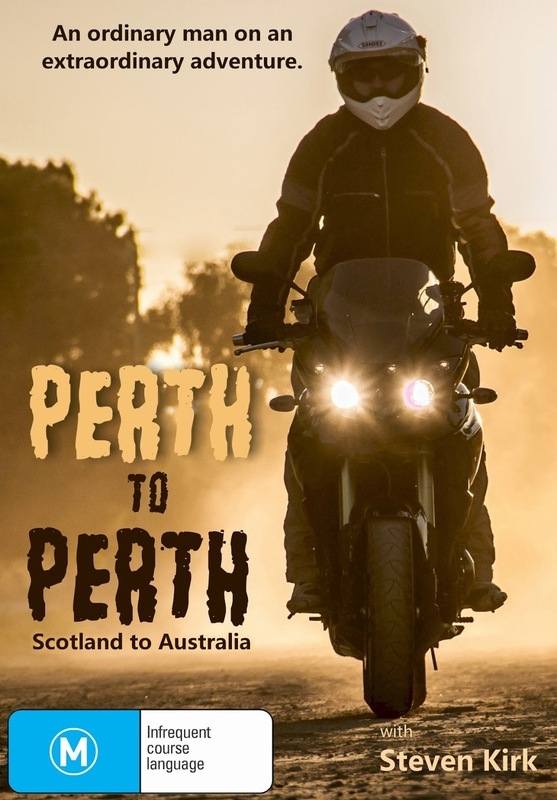 Steven Kirk a long time resident in Perth reaches middle age and decides that the world has more to offer the keen motorcyclist. Inspired by pioneers who first arrived on Australian shores centuriesearlier, Steven tried to recapture some of that excitement by travelling on his own quest from theoriginal Perth in Scotland. Hoping to feel similar experiences of the long journey by land, taking him through the Middle East and across the top end of Australia before arriving home in Perth. Steven Kirk a long time resident in Perth reaches middle age and decides that the world has more to offer the keen motorcyclist. Inspired by pioneers who first arrived on Australian shores centuriesearlier, Steven tried to recapture some of that excitement by travelling on his own quest from theoriginal Perth in Scotland. Hoping to feel similar experiences of the long journey by land, taking him through the Middle East and across the top end of Australia before arriving home in Perth.
The DVD initially aimed at motorcyclists has seen interest from the general public in looking at the different cultures and countries travelled through. Described as gritty and truthful, perhaps with some rough edges but with an interesting story of an ordinary bloke on an extraordinary journey.
The DVD is available in Australia and UK via website purchase www.perthtoperth.com and selected motorcycle shops in Australia.
What started out as a hobby to record the trip has turned into an epic TV series, aimed primarily to inspire others, now supporting charities with the benefit of sales worldwide. In UK all profits go to Help for Heroes. Help for Heroes give practical, direct support to our current wounded
Some comments from adventure motorcycle forums and emails:
"One of the best and easiest to watch amateur films"
"They really are fantastic, arguably one of the best produced and edited shows since Long Way Round"
"Excellent. The presentation was superb. Top Bloke"
"I hope you enjoyed the trip as much as I enjoyed watching it. Great adventure....some tense moments there in Pakistan"
“Absolutely brilliant, great achievement”
About Steven
Originally from Scotland, now living in Australia for past 22 years, Steven runs a successful Fire Engineering consultancy in Perth. Motorcycling is in his blood, having ridden in several countries with famous names such as Charley Boorman [Long Way Round, Long Way Down, By any means, Worlds Most Dangerous roads] , Ross Noble comedian, Simon Pavey [Race to Dakar and Long Way Round], Ted Simon [Jupiter’s Travels] he has joined the list of many who partake in motorcycling adventures on a almost routine basis. Now he is planning the next big adventure, Alaska in USA to the Southern tip of Argentina later this year which will also be recorded for TV.
www.perthtoperth.com

-
Thomas Ramette, aboard his Honda CRF450R fitted with Michelin Starcross MS3 tyres, dominated the final round of the Garmin Arenacross Tour on Saturday evening, taking a flag-to-flag victory in the Main Event at London’s Wembley Arena.
After gelling quickly with the Wembley track, the French rider also took impressive victories in both his earlier heats riding for Dave Thorpe’s Michelin-sponsored team. Taking first place in the first heat, Ramette was followed across the line by Italian team-mate Angelo Pellegrini, who finished in third place and Luke Arbon who came in fifth.
In the second heat Pellegrini finished second behind Ramette, while Arbon recovered well from a first-corner crash to cross the line in fifth place once again. Ramette continued his domination of the evening in Wembley’s Main Event, while Pellegrini rode into fifth. The Michelin-sponsored team ended the series in fifth place overall. The squad will now focus on the opening round of the British Motocross Championship which kicks off at Landrake in Cornwall on 16 March.
Thomas Ramette: "It was a great night as I won both my heats and the Main Event so it was perfect for me. The track was really slippery and you had to ride smooth, so I'm really happy to finish the season with a win."
Angelo Pellegrini: "I'm not 100% happy, because I wanted to finish the season on the podium again like the last round. The track and the event was really good this evening and I hope to be able to come back in the future."
Luke Arbon: "Today was a little bit of a let-down as I felt really good on the bike and qualified with a good lap time. I just suffered a little bit with the outside gate picks and struggled with my starts. The track was really slippery tonight, but I can't thank Dave and the team enough for everything that they have done."
Dave Thorpe: "Tonight has been very good for the team and Thomas has fulfilled the potential that he showed at Sheffield. He is a quality rider in Arenacross and I'm pleased for him as he worked hard this week and is a great guy to work with. Angelo has also been great for us in this series and now just needs to focus on improving his starts. Luke is another great rider and has done so well on the smaller machine.”
Find out more about motorcycling with Michelin at www.moto.michelin.co.uk
Michelin, the leading tyre company, is dedicated to sustainably improving the mobility of goods and people by manufacturing and marketing tyres for every type of vehicle, including aeroplanes, cars, bicycles/motorcycles, earthmovers, farm equipment and trucks. It also offers electronic mobility support services on ViaMichelin.com and publishes travel guides, hotel and restaurant guides, maps and road atlases. Headquartered in Clermont-Ferrand, France, Michelin is present in more than 170 countries, has 111,200 employees and operates 67 production plants in 17 different countries. The Group has a Technology Centre in charge of research and development with operations in Europe, North America and Asia.
-
A specialist education centre has been set up at the MCI’s headquarters in Coventry, which has been awarded official accredited status, in order to provide a programme of new qualifications for motorcycle instructors and motorcycle training businesses.
The Motorcycle Industry Accreditation Centre was officially approved by the Institute of the Motor Industry (IMI) last year - to run new vocational courses for both instructors and Approved Training Bodies (ATBs), which will begin in April.
Help for customers
Customers currently have no means of distinguishing good from bad when choosing an instructor or ATB. This is particularly important when choosing where to do Compulsory Basic Training (CBT), as the quality of this initial training experience is far more likely to win converts to motorcycling when delivered well. Also, those who invest time and money into building a superior business have no concrete way to stand out from less scrupulous operators.
Professionalising the industry
Introducing qualifications for instructors and ATBs will allow the motorcycle training industry to professionalise ahead of any compulsory requirements to do so and before the car training industry has managed to do the same.
These vocational qualifications will be equivalent to level 3 (approximately A level standard) and though they are voluntary, they will demonstrate to customers that the instructor or ATB involved will far exceed any minimum standards.
Vocational Qualifications are work based awards that are achieved through assessment and training, which require the candidates to prove that they have the ability to carry out their job to a required standard.
Welcomed by the wider industry
MCI members also agree that more structure within the training industry will allow them to choose training partners more easily and to develop fleet programmes with corporate clients who need greater quality assurances than are currently available.
The individual instructor training qualification will start in January 2015, but the first ATB course will begin in a few weeks’ time in April of this year. 20 ATBs will be given the chance to be the first in the UK to take a qualification specifically tailored to them. This can be taken by owners, directors, managers or whoever has responsibility for the day to day running, as it concentrates on the business of running an ATB. Those seeking instructor accreditation next year will need to be part of an ATB which has gained MCIAC ATB accreditation.
Steve Kenward, CEO of the Motorcycle Industry Association explained: “Driver and motorcycle training has been left behind other training sectors in introducing a framework of recognised qualifications. This move should help to change that. Motorcycles should be a natural choice as a means of personal transport and for fleet operators too, but both need clearer signposts when choosing quality instructors. We are particularly proud to be able to launch this ahead of anything similar in the car driver training industry and before any compulsory requirements to do so by government bodies.”
Karen Cole, Director of Safety and Training at the MCI, who has been instrumental in leading the bid to get accredited status for the MCI added: “Many working in the motorcycle training industry agree that the industry has suffered from a lack of recognition and professional status for too long and that needs to change. Accreditation fits into a long term strategy to deliver a ‘route to safer motorcycling’ model, which is a shared aim for MCI members and the Motorcycle Industry Association Trainers Association (MCITA). We are sure that if we can improve rider safety and raise the professionalism and credibility of the industry overall, we can expect much more support from government, manufacturers and other key stakeholders.”
Cost
The ATB course will normally be £1575, although there is an introductory offer for an initial 20 ATBs, which can be paid for in instalments. The intro offer is only for MCITA members who take a place on either the April or June course. ATBs interested in finding out more should contact the Course Administrator Lynne Whitehouse on 02476 408036 [email protected]
Instructor training will take place from January 2015 and anyone wishing to take part will need to be affiliated to an MCIAC accredited ATB.
www.mcia.co.uk
|