| | Biker News - Regularly updated
-
|
With the all new Aventuro Travel Carbon, Touratech presents an exciting new development in its successful flip-up helmet range. State-of-the-art materials, a practical design and extensive features make this premium helmet a comfortable companion – from holiday trips and adventure tours to everyday use.
X-Pro Carbon: maximum strength with minimum weight
The basis of the Aventuro Travel Carbon is a completely newly developed helmet shell made of X-Pro Carbon, a high-performance composite material with a fibre content of over 60 percent. Through the use of 3K carbon fibres (3,000 fibres per bundle), the material is exceptionally light with outstanding strength.
Around 10 per cent lighter than conventional designs, the helmet shell is manufactured in two sizes to ensure the optimum ratio between the outer shell and EPS liner for each helmet size.
Approved as a full-face and jet helmet (P/J homologation)
The Aventuro Travel Carbon of course complies with the current ECE 22-06 standard. In addition, it is double homologated (P/J), which means that it can also be legally ridden with the chin section raised.
Locking is realised by a precise mechanism made of stainless steel components, which ensures accurate engagement, durability and ease of use – even in dusty and dirty conditions.
Comfort and climate: interior design with X-MART Dry and Morpho Fit system
The interior of the Aventuro Travel Carbon is designed for maximum comfort. The X-MART Dry material offers excellent moisture management and a pleasantly dry feel, even in high temperatures.
The Morpho Fit system allows for individual adjustment in the cheek area, while the 3D-shaped inner padding and integrated multi-channel ventilation ensure gentle skin contact and optimum air circulation. The lining is, of course, removable and washable.
The seamless, removable inner lining incorporates multi-channel ventilation for optimal air circulation. Fresh air is supplied via a highly efficient ventilation system with two closable inlet openings at the front and two outlets at the rear of the helmet. The central element of the air management system is the patented Mid Airflow Chamber, which creates a volume between the inner and outer EPS shells.
Optimised acoustics
Touratech has comprehensively optimised the Aventuro Travel Carbon in terms of aeroacoustics. The helmet shell shape with integrated rear spoiler, the flow-optimised chin guard and the lightweight helmet visor minimise turbulence and wind noise.
The visor closure with double Silent Travel Seal and newly developed anti-noise cheek and neck pads provide additional peace and quiet in the helmet, enabling effective sound insulation. The result is a pleasantly quiet background noise level that promotes concentration and reduces fatigue on long journeys.
Features for travel and adventure
The panoramic field of vision provides excellent round view and unrestricted sight of the landscape. An integrated, continuously adjustable sun visor provides reliable protection in changing light conditions. The adjustable peak reduces glare when the sun is low.
The Touratech Aventuro Travel Carbon is designed for use with modern intercom systems; the Nexx X.COM3 and X.COM3 PRO systems can be seamlessly integrated. The scope of delivery also includes two action cam mounts – for mounting on the side and on top.
Touratech Aventuro Travel Carbon | Technical highlights
- Helmet shell made of X-Pro Carbon
- Certified according to ECE 22-06
- Double homologated (P/J)
- Two shell shell sizes, seven fits from XS to 3XL
- Aerodynamic helmet shield, specially developed for adventure use
- Visor closure with Silent Travel Seal for optimised sound insulation and sealing effect
Efficient ventilation system with two inlet and two outlet openings
- X-MART Dry inner lining with Morpho Fit system, removable and washable
- Integrated sun visor, easy to operate even with gloves on
- Action cam mounts included (top and side)
- Intercom preparation for Nexx X.COM3 / X.COM3 PRO
- Stainless steel micrometer closure
The all new Touratech Aventuro Travel Carbon is now available in seven sizes (XS–3XL). Item-no.: 500-2770 ff.
Further information in the Touratech webshop
|
|
-
Four decades of one of the most important and iconic lines of sportsbikes will be celebrated at MCL [Motorcycle Live] 2025, when Suzuki marks the 40th anniversary of GSX-R.
The 1985 GSX-R750F transformed the world of sportsbikes and laid the foundations for every sportsbike that’s followed since, through to the reveal of the new GSX-R1000R 40th Anniversary Edition earlier this year. To mark the milestone, a dedicated display will celebrate arguably the most significant and legendary motorcycling lineages in history.
The lineup will feature a number of models from the GSX-R’s history, including a 1985 GSX-R750. Other notable inclusions include a GSX-R750 SRAD and a K5 GSX-R1000.
And, to kickstart the MCL celebrations, Suzuki will host a special VIP event on the morning of Saturday 15 November – the opening day of MCL 2025 – which will take place on the Suzuki stand an hour before the show opens to the public. The event will celebrate both the anniversary and the launch of the new GSX-R1000R, with attendance by invitation only and open to customers that have placed a deposit on the 2026 GSX-R1000R 40th Anniversary Edition.
Hosted and compered by renowned presenter and broadcaster Grace Webb, it will include insight into the new GSX-R from Paul de Lusignan, Suzuki GB’s director of motorcycles, followed by talks with 2024 Endurance World Championship winner Dan Linfoot, who also recently won the 2025 Bol d’Or with the Yoshimura Suzuki Endurance Team, and 2004 British Superbike champion and former GSX-R test rider, John Reynolds.
VIPs will receive a goody bag, the chance to meet and talk with Linfoot, Reynolds, and the Suzuki GB team, and get a first look at the GSX-R1000R 40th Anniversary Edition in the metal before anyone else in the UK.
Suzuki GB marketing manager, Jak Tyrrell, said, “I think it’s fair to say that no other range of motorcycles has moved the game on in the way that GSX-R has over the last four decades, or has played such a big part in the motorcycling journey of so many riders over the years. 40 years is an incredible milestone, and we’re really excited to be able to celebrate such an anniversary at MCL, talk with owners old and new about their GSX-R history, all ahead of the arrival of the anniversary edition next year.”
In 1985 the GSX-R750F became a landmark moment in production sportsbike design, delivering genuine track performance on the road to the masses, combining a lightweight aluminium chassis with a race-derived, oil-cooled four-cylinder engine. The GSX-R1100 followed the following year, doubling the GSX-R stable, becoming the big-bore sportsbike of choice.
Evolution became revolution with the arrival of the GSX-R750 SRAD in 1996. Based on the dimensions and ergonomics of Kevin Schwantz’s 1993 Grand Prix World Championship-winning RGV500 and with a new twin-spar aluminium frame and compact, high-revving engine, it brought the GSX-R closer than ever to Suzuki’s factory race bikes.
The first GSX-R600 followed in 1997, and, with the discontinuation of the GSX-R1100, the first GSX-R1000 was released in 2001, again moving the sportsbike game on a stage further, with a power-to-weight ratio that redefined superbike standards. It won the British Superstock championship in its first year with Aussie Paul Young, and again in its second and third years of competition. The 2005 GSX-R1000 K5, four years later, built on that foundation and brought further advances, winning the World Superbike Championship at the hands of Troy Corser. It remains revered today, 20 years on.
The 2011 GSX-R750 and 600s were widely-praised following their release, with the 600 going on to win the British Supersport Championship in its first year with Alastair Seeley. The GSX-R1000 underwent its final evolution in 2012 before being completely redesigned for 2017.
Incorporating MotoGP-derived technology – most notably with a clever variable valve timing system – the L7 GSX-R1000R was again widely praised for its track performance but also its civility as a road-going superbike. It won that year’s Senior TT with Michael Dunlop onboard, and after finishing runner-up twice, it won the 2019 National Superstock 1000 championship courtesy of Richard Cooper.
Where GSX-Rs – and the 1000 in particular – have dominated is in the Endurance World Championship. Unlike sprint superbike and superstock racing, endurance racing is not only a test of performance but reliability, and the GSX-R1000 has won the world title 15 times, its latest coming in 2024.
Suzuki is looking to make it 16 world titles in 2026, and the new GSX-R1000R 40th Anniversary Edition goes on sale in the UK in the spring.
For more information on the GSX-R1000R 40th Anniversary Edition click here.
At MCL Suzuki can be found on stand 3D25 in hall 3A.
-
|
ALEX MARQUEZ #73
“Today I changed my approach at the start of the race, as yesterday I got it wrong, as I attaked and did what I aimed to do. We had a great race and achieved the goal of becoming the best independent team from the top of the podium; now we’ll enjoy these last two races.”
FERMIN ALDEGUER #54
“It wasn’t the best way to wrap up a weekend where we were really strong and where we felt very competitive. We achieved a goal and in today’s race we learned a lot. I hit hard during the crash, but we’re going back home to recuperate.”
|
Raceday - MalaysianGP
1st - ALEX MARQUEZ #73
NC - FERMIN ALDEGUER #54
World Championship Standings
2nd - ALEX MARQUEZ #73 (413 points)
Runner Up MotoGP 2025
8th - FERMIN ALDEGUER #54 (186 points)
Rookie of the Year 2025
|
|
|
|
|
|
-
-
Lucky Royal Enfield riders in the UK have now taken delivery of their highly-anticipated, limited-edition Shotgun 650 ICON Edition motorcycles.
-
Designed by Royal Enfield in collaboration with ICON Motosports, as a global 1-of-100 limited run - 6 available to the UK, 26 in Europe, 26 in India, 17 Americas, 25 APAC.
-
Limited-run edition made in collaboration with the custom and lifestyle apparel powerhouse, ICON Motosports.
-
Inspired by ICON Motosports ‘Always Something’ custom build, first unveiled at EICMA 2024, and ridden up the hill at Goodwood Festival of Speed.
-
Future limited-edition Royal Enfield motorcycles are on the horizon. For details, contact your local Royal Enfield dealership.
Lucky Royal Enfield riders across the UK have now taken delivery of their limited-run Shotgun 650 ICON Edition motorcycles, marking the end of a highly anticipated wait.
Highly sought after by riders and enthusiasts, just 6 Royal Enfield fans were able to get their hands on the ICON Edition Shotgun 650 - all selected at random from online entries, with just 100 available globally - 6 available to the UK, 26 in Europe, 26 in India, 17 Americas, and 25 APAC.
The final two ICON Edition units were recently handed over at Drayton Croft Motorcycles in Hinckley, while the very last UK-allocated motorcycle delivered through Sycamore Motorcycles in Peterborough.
This exclusive Shotgun 650 was crafted in collaboration with ICON Motosport, with its design taking direct inspiration from the ‘Always Something’ ICON-built custom motorcycle first unveiled at EICMA 2024. The bike captures ICON’s distinctive style and Royal Enfield’s custom culture in one iconic road-going package.
The ‘Always Something’ custom build, aptly named after ICON’s test rider crashed it a mere three weeks before the bike was due to debut at EICMA, Milan, has since been shown and ridden at various shows attended by the Royal Enfield Custom World team throughout the year, from the London Bike Shed Moto Show 2025, to Wheels & Waves in France, and recently seen conquering the famous hill at the Goodwood Festival of Speed 2025.
Adrian Sellers, Head - Custom & Motorsport at Royal Enfield said
"It's exciting to see these unique motorcycles finally arrive with their lucky owners. This was a very special project with us, and working with Icon Motosport allowed us to really show off the potential of the Shotgun 650. This release underscores Royal Enfield’s commitment to creating special, distinctive motorcycles that resonate with our community. The Shotgun 650 ICON Edition is a testament to Royal Enfield’s rich heritage of customisation and the passion of our riders.”
ICON are specialists when it comes to creating the outrageous, and the ICON Edition Shotgun 650 is designed to embody the Shotgun’s ‘Inspired by Custom. For Custom’ mantra. Key elements include the limited ICON One Thousand colourway, accentuated by gold rims with contrast cut details, and finished with bar-end mirrors, blue shock springs, and a distinctive red seat. This head-turning style is designed to catch the eye and speak for itself.
Each new Shotgun 650 ICON Edition owner not only secured a truly unique 1-of-100 machine, but also received an exclusive ICON Edition jacket that matches their bike - designed exclusively for the new owners and custom-made to order.
Royal Enfield Shotgun 650
Inspired by custom. For custom. The Shotgun 650 is a motorcycle that defies categorisation, transforming in minutes from a single seat bobber, to a weekend tourer, to a dual seater roadster and back. A machine that pays homage to the past while hurtling towards the future, a tribute to self-expression. Each one is engineered to be a canvas for artists, custom builders and riders across the world — an invitation to create a Royal Enfield unlike any other.
When it comes to performance, the Shotgun 650 is powered by the famed 648cc air-oil cooled parallel-twin, with a torquey grunt and entirely usable roadgoing character. Under the unshakable steel spine of the Shotgun 650 is the proven 648cc parallel twin engine, designed for real world usage with a strong mid-range and ample torque across the gears to keep the rider engaged.
A true riders’ motorcycle, the Shotgun 650 offers an ergonomic design with mid-set foot pegs, a low 795mm seat, and well-placed handlebars. Its Showa suspension, 1465mm wheelbase, and low centre of gravity provide comfort and agility in various riding conditions. Wide 18" front and 17" rear tyres, along with 320mm and 300mm disc brakes, ensure excellent grip and control at all speeds, for all riders.
The ‘Always Something’ motorcycle that inspires this limited edition marvel is long, low and loud, featuring heavily-modified geometry, under-tail twin shocks and a stars-and-stripes style livery.
The Shotgun 650 ICON Edition, even if a limited production run, is a motorcycle that carries Royal Enfield’s pure motorcycling DNA without being constrained by it; emphasising the potential for creating a truly raw and original custom-designed motorcycle that breaks the mould and pushes the boundaries.
Looking Ahead
Royal Enfield is always striving to create rider-focused motorcycles, with this Shotgun 650 ICON Edition just one of many potential ideas that have been explored.
Further potential ideas are always being dreamt up, particularly based on customer demand at UK dealerships for future special limited edition releases.
Shotgun 650 ICON Edition Photo Gallery: https://royalenfieldmedia.co.uk/folders/165
ICON Motosport ‘Always Something’ Photo Gallery: https://royalenfieldmedia.co.uk/folders/145
For all media enquiries, including press fleet requests, please get in touch with the Motocom team at [email protected] or call +44 (0) 1525 270100.
About Royal Enfield
The oldest motorcycle brand in continuous production, Royal Enfield has created beautifully crafted motorcycles since 1901. From its British roots, a manufacturing plant was established in Madras in 1955, a foothold from which Royal Enfield spearheaded the growth of India’s mid-sized two-wheeler segment. Royal Enfields are engaging, uncomplicated, accessible and fun to ride; a vehicle for exploration and self-expression. It’s an approach the brand calls Pure Motorcycling.
Royal Enfield’s premium line-up includes Bear 650, Classic 650, Guerrilla 450 modern roadster, Hunter 350, Meteor 350, Super Meteor 650, Interceptor 650 and Continental GT 650 twins, the Shotgun 650, the new Himalayan adventure tourer, the Scram 440 ADV Crossover, the iconic Bullet 350, Classic 350 and Goan Classic 350. The company recently unveiled its new city+ motorcycle brand – the Flying Flea – a fresh take on urban mobility, blending authentic design with advanced technology.
Riders and a passionate community are fostered with a rich profusion of events at a local, regional and international level. Most notable are Motoverse (previously Rider Mania), an annual gathering of thousands of Royal Enfield enthusiasts in Goa, and Himalayan Odyssey; a yearly pilgrimage over some of the toughest terrain and highest mountain passes.
A division of Eicher Motors Limited, Royal Enfield operates through more than 2000 stores across all major cities and towns in India and through nearly 850 stores in more than 60 countries around the globe. Royal Enfield also has two world-class technical centres, in Bruntingthorpe, UK, and in Chennai, India. The company’s two state-of-the-art production facilities are located at Oragadam and Vallam Vadagal, near Chennai. Across the world, Royal Enfield has six modern CKD assembly facilities in Bangladesh, Nepal, Brazil, Thailand, Argentina and Colombia.
-
Running a motorcycle blog is about more than just sharing your love for the open road — it’s about creating a space where riders can find inspiration, advice, and reliable information. However, even the most exciting bike reviews or riding stories won’t reach their audience if your blog isn’t optimized for Google. Search Engine Optimization (SEO) ensures that your content ranks higher, helping more motorcycle enthusiasts discover your blog through organic search. 
Many motorcycle bloggers face challenges like low search visibility or slow audience growth, but with the right SEO techniques, you can overcome these obstacles. For more insight into building an effective digital strategy within the motorcycle niche, Revolution Motorcycle Marketing offers helpful resources on optimizing websites and improving online performance. This guide will take you through every step — from keyword research and on-page optimization to improving site performance and earning backlinks. By following these strategies, you’ll make your motorcycle blog more discoverable, engaging, and ultimately, a go-to hub for passionate riders around the world.
Understanding SEO Basics for Motorcycle Bloggers
If you run a motorcycle blog, you’ve probably heard about SEO, but it can feel confusing at first. Simply put, SEO (Search Engine Optimization) is the practice of improving your blog so it ranks higher on Google and other search engines. This is especially important for motorcycle content, whether you’re writing about bike maintenance, touring routes, gear reviews, or riding tips. Good SEO ensures your posts reach the right audience — riders who are actively searching for the information you provide.
Google decides which pages to show at the top based on several factors:
- Content relevance: How well your page matches the user’s search query.
- Authority: The credibility of your site, influenced by backlinks and online reputation.
- User experience: Site speed, mobile-friendliness, and ease of navigation.
For motorcycle bloggers, SEO is more than just a technical tool — it’s a way to share your passion with people who are looking for it. Without it, even the most detailed reviews or travel guides may remain unseen. With proper optimization, your blog can attract loyal readers who are genuinely interested in motorcycles.
How SEO Works: Key Areas to Focus On
To improve your blog’s SEO, you need to focus on three main areas:
On-Page SEO
- Optimize keywords naturally in titles, headings, and content.
- Write clear meta descriptions to summarize your posts.
- Include internal links to guide readers to related content.
Off-Page SEO
- Build backlinks from reputable motorcycle sites, forums, or guest posts.
- Encourage social sharing to increase visibility and credibility.
Technical SEO
- Improve site speed and mobile responsiveness.
- Fix broken links and ensure a smooth user experience.
- Submit sitemaps to help search engines index your content efficiently.
Why SEO Matters for Motorcycle Blogs
SEO allows niche blogs to compete with larger motorcycle websites. By focusing on specific topics, your blog can attract the exact readers who want your content. For example:
- How-to guides on upgrading bike parts
- Reviews of touring routes or gear
- Tips for long-distance riders or commuting bikers
Strong SEO ensures that your content doesn’t just exist online — it gets discovered, read, and shared by enthusiasts.
Understanding Your Target Audience
Knowing your audience is crucial for effective SEO. Motorcycle readers are diverse:
- Commuters: Look for affordable maintenance and practical riding tips.
- Weekend riders: Interested in scenic routes, gear, and community events.
- Adventure riders: Seek long-distance touring advice, safety tips, and packing guides.
By understanding what your readers want, you can create content that answers their questions and keeps them returning for more.
Keyword research is one of the most important steps for a successful motorcycle blog. It helps you understand what riders are searching for and ensures your content aligns with their needs. Without proper keyword research, even the best-written posts may remain unseen. By targeting the right search terms, you can attract readers who are genuinely interested in motorcycles, bike maintenance, touring, and gear reviews.
Why Keyword Research Matters for Motorcycle Blogs
Keyword research allows you to:
- Identify what topics riders are searching for online.
- Understand search intent to create content that answers questions.
- Drive organic traffic to your blog without paid advertising.
- Compete with larger motorcycle websites by focusing on niche topics.
How to Find Motorcycle-Related Keywords 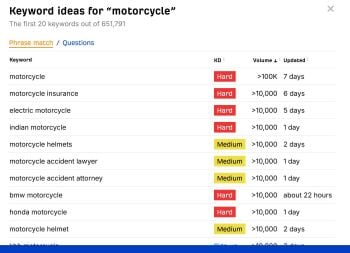
There are several tools to discover high-value keywords for your blog:
- Google Keyword Planner: Provides search volume and competition data.
- Ubersuggest: Shows related keywords and trends in the motorcycle niche.
- Ahrefs: Offers comprehensive insights, including keyword difficulty, backlinks, and competitor analysis.
By using these tools, you can find keywords that match your blog’s content and attract the right type of traffic.
Long-Tail Keywords for Motorcycle Blogs
Long-tail keywords are longer, more specific search phrases. They usually have lower competition and attract visitors with higher engagement. Examples include:
- For touring content: “best touring motorcycles for beginners,” “motorcycle road trips in Europe”
- For maintenance guides: “DIY motorcycle oil change guide,” “how to replace motorcycle brake pads”
These specific phrases help you reach readers who are actively looking for detailed information and are more likely to interact with your content.
Using Intent-Based Keywords Effectively
Understanding search intent ensures your content meets readers’ needs:
- Informational keywords: Users are seeking advice or tutorials, e.g., “how to maintain a motorcycle chain.”
- Transactional keywords: Users are ready to buy or take action, e.g., “best motorcycle helmets to buy online.”
- Commercial/Research keywords: Users are comparing options, e.g., “Suzuki Boulevard M50 vs Harley Softail comparison.”
Matching keywords with the right intent improves engagement and increases the chance that visitors stay on your site longer.
Where to Place Keywords on Your Blog
Strategic keyword placement helps search engines understand your content and improves rankings:
- Titles: Include primary keywords naturally in blog post titles.
- Headings (H1, H2, H3): Use secondary or long-tail keywords to structure content.
- Meta descriptions: Summarize posts with keywords to improve click-through rates.
- Alt tags for images: Describe images with relevant keywords, e.g., “Suzuki Boulevard M50 side view.”
- Internal linking: Link to related posts to guide readers and strengthen SEO.
Examples of Effective Motorcycle Keywords
- Travel riders: “motorcycle road trips in Europe,” “best scenic motorcycle routes”
- Maintenance blogs: “DIY motorcycle oil change guide,” “motorcycle tire pressure tips”
- Bike reviews: “Suzuki Boulevard M50 review,” “Harley Davidson Street Glide pros and cons”
Using research tools, long-tail keywords, intent-based strategies, and smart placement ensures your content reaches the right audience and ranks higher in search engines.
Creating SEO-Friendly Motorcycle Blog Content: A Step-by-Step Guide
High-quality content is the heart of any successful motorcycle blog. Writing engaging, informative, and SEO-optimized posts not only attracts readers but also helps your site rank higher in Google. Whether you’re sharing riding stories, gear reviews, or route guides, following a structured process ensures your content performs well and keeps readers coming back.
Step 1: Understand Your Audience and Purpose
Before writing, know who you’re targeting:
- Commuters: Looking for practical tips and maintenance advice.
- Adventure riders: Interested in touring routes, long-distance tips, and gear recommendations.
- Casual enthusiasts: Reading bike reviews, event coverage, and lifestyle stories.
Understanding your audience enables you to select the appropriate tone, keywords, and content type. Ask yourself: What problems does my reader want to solve? What questions are they asking online
Step 2: Conduct Keyword Research
Keyword research forms the foundation of SEO-friendly content. Use tools like:
- Google Keyword Planner for search volume and trends.
- Ubersuggest for related keywords and suggestions.
- Ahrefs for competitor keyword analysis.
Focus on long-tail and intent-based keywords:
- Informational: “How to maintain a motorcycle chain”
- Transactional: “best motorcycle helmets to buy online”
- Commercial: “Suzuki Boulevard M50 review vs Harley Softail”
Place primary keywords in titles, headings, meta descriptions, and naturally throughout the article.
Step 3: Create an Outline for Your Post
A clear structure improves readability and SEO. Consider this format:
- Introduction: Hook readers with a question, story, or problem.
- Main sections: Use H2 and H3 headings to organize content.
- Riding experiences (storytelling)
- Gear or motorcycle reviews (informative content)
- Route or maintenance tips (practical guides)
- Conclusion: Summarize key takeaways and include a call-to-action (CTA).
An outline ensures your article flows logically and makes it easier for readers and search engines to understand.
Step 4: Write High-Quality, Engaging Content
Content should be informative, engaging, and easy to read:
- Balance storytelling (riding experiences, trips, adventures) with practical information (gear reviews, bike maintenance, route suggestions).
- Keep sentences concise and paragraphs short to improve readability.
- Use bullet points and numbered lists for tips, instructions, or steps.
- Include examples or personal experiences to make your posts relatable.
Step 5: Optimize for Readability and SEO
SEO-friendly content is also reader-friendly:
- Use H1 for the title, H2 for main sections, and H3 for subpoints.
- Break up text with headings, bullet points, and short paragraphs.
- Include internal links to relevant posts, e.g., other bike reviews, route guides, or maintenance tips.
- Add external links to authoritative sites when necessary to improve credibility.
- Make your meta description compelling and keyword-rich.
Step 6: Add Multimedia to Enhance Engagement
Visual content improves dwell time, understanding, and shareability:
- Images: Include high-quality photos of motorcycles, routes, or gear.
- Videos: Share ride footage, tutorials, or review demonstrations.
- Infographics: Use diagrams for maintenance tips or comparison charts.
Step 7: Edit, Proofread, and Optimize
Before publishing:
- Check for grammar, spelling, and readability.
- Ensure keywords appear naturally, not forced.
- Verify all links (internal and external) work correctly.
- Test page speed and mobile responsiveness for a smooth user experience.
Step 8: Publish and Promote
Once your post is ready:
- Share it on social media platforms and motorcycle forums.
- Include it in newsletters or email campaigns to your subscribers.
- Engage with readers through comments to build community and encourage sharing.
Image Optimization for Motorcycle Blogs 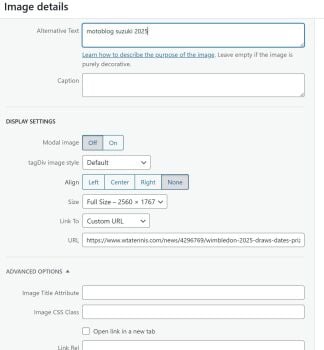
Motorcycle blogs often rely heavily on visuals — from high-quality bike photos to scenic riding routes. Optimizing these images for SEO is crucial because they can significantly impact your blog’s performance in search engines and user experience. Large, unoptimized images can slow down your site, leading to higher bounce rates and lower rankings, while well-optimized visuals can improve load times, accessibility, and even drive additional traffic through Google Image Search.
Here are key strategies for effective image SEO on your motorcycle blog:
- Use descriptive file names: Instead of generic names like “IMG_1234.jpg,” use specific, keyword-rich names such as “custom-harley-davidson-bike.jpg” or “yamaha-mt09-tour-ride.jpg.” This helps search engines understand the content of your images.
- Add meaningful alt tags: Alt text not only improves accessibility for visually impaired readers but also provides context to search engines. A good alt tag describes the image accurately, e.g., “red Ducati Monster parked on a mountain road.”
- Compress images for faster loading: Large images can slow down your blog, hurting both user experience and SEO. Tools like TinyPNG, ShortPixel, or ImageOptim can reduce file size without sacrificing quality.
- Choose the right format: JPEGs are ideal for photos, PNGs work well for graphics with transparency, and WebP offers high-quality compression for web use. Choosing the correct format helps your pages load faster.
- Leverage image search for extra traffic: Optimized images can appear in Google Image Search, bringing in visitors who may not find your site through traditional search results. Include relevant captions and context around your images to increase the chances of ranking.
By following these image optimization techniques, your motorcycle blog will not only look great but also perform better in search rankings. Properly optimized visuals make your content more engaging for readers and provide additional opportunities to attract organic traffic from image searches, helping your blog grow in both reach and authority.
Technical SEO for Motorcycle Bloggers: Boost Site Speed, Performance, and Rankings
Technical SEO is the foundation of a high-performing motorcycle blog. Even the best content can struggle to rank if your website has slow loading times, poor mobile responsiveness, or weak security. By optimizing your technical setup, you improve user experience, increase dwell time, and signal to Google that your site is trustworthy and reliable.
Why Technical SEO Matters for Motorcycle Blogs
Motorcycle blogs often feature high-resolution images, videos, and multimedia content, which can slow down your site if not optimized. Technical SEO ensures that:
- Pages load quickly for desktop and mobile users.
- Your site is secure, fast, and accessible.
- Search engines can crawl, index, and display your content effectively.
A technically sound blog not only helps with rankings but also keeps readers engaged.
Optimizing Core Web Vitals for Better Rankings
Core Web Vitals are Google’s key metrics for measuring user experience. Focus on:
- Largest Contentful Paint (LCP): Make sure your main content loads quickly. Compress images, use optimized formats, and reduce server response time.
- First Input Delay (FID): Improve page interactivity by minimizing JavaScript and avoiding heavy scripts.
- Cumulative Layout Shift (CLS): Prevent layout shifts by setting fixed sizes for images and ads.
Optimizing these metrics can improve search visibility and reduce bounce rates.
Implementing Structured Data
Structured data (schema markup) helps search engines understand your content and can enhance your search listings with rich snippets. For motorcycle blogs, consider using:
- Article schema for blog posts and reviews.
- Product schema for gear reviews or bike comparisons.
- Breadcrumb schema for better navigation in search results.
Properly structured data can increase click-through rates by making your listings more visually appealing and informative.
Sitemap and Robots.txt Setup
A sitemap helps search engines discover all pages on your site, while the robots.txt file controls which pages are crawled. Key tips include:
- Create an XML sitemap and submit it to Google Search Console.
- Ensure your sitemap includes all important posts, categories, and pages.
- Configure robots.txt to prevent the indexing of unnecessary or duplicate pages.
This setup improves crawl efficiency and ensures that all valuable content is discoverable.
Speed and Performance Enhancements
Motorcycle blogs often include heavy media like high-resolution images and videos. Optimizing technical performance involves:
- Caching: Store static versions of pages to reduce server load.
- CDNs (Content Delivery Networks): Deliver content faster to users across different locations.
- Lazy Loading: Load images and videos only when users scroll to them.
- Image Optimization: Compress and resize images for faster page load.
Implementing these techniques ensures a faster, smoother browsing experience for readers, which is crucial for keeping them engaged.
Security and Mobile Responsiveness
- HTTPS: A secure site protects user data and is a ranking factor.
- Mobile-first design: Ensure your theme is responsive and readable on smartphones and tablets.
- Regular updates: Keep plugins, themes, and WordPress core up to date to prevent vulnerabilities.
A secure, mobile-friendly blog not only boosts SEO but also builds trust with your readers.
Running a successful motorcycle blog isn’t just about passion for bikes — it’s about making sure your content reaches the right audience. By understanding SEO basics, conducting thorough keyword research, writing engaging posts, and optimizing technical performance, you can attract readers who are genuinely interested in motorcycles, riding tips, and gear reviews.
Key strategies to remember:
- SEO fundamentals: Optimize content relevance, authority, and user experience.
- Keyword research: Use long-tail and intent-based keywords to target riders effectively.
- Content creation: Balance storytelling, reviews, and practical guides for maximum engagement.
- Technical SEO: Improve site speed, mobile responsiveness, security, and structured data.
- Multimedia and links: Incorporate images, videos, and internal links to enhance usability and dwell time.
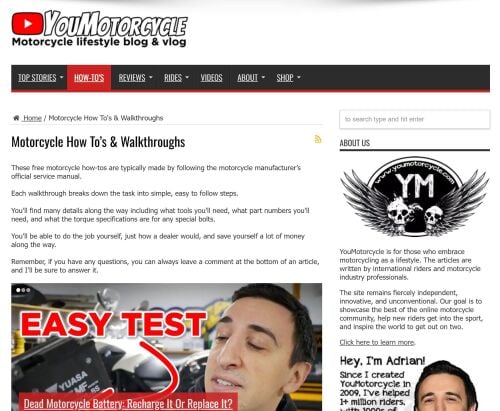
To see how a motorcycle blog applies these strategies successfully, check out YouMotorcycle Lifestyle and blog, which features a mix of reviews, ride stories, and how-to guides crafted for both readers and search engines. Studying well-structured posts like these can inspire your own content and help your blog stand out in the competitive motorcycle niche.
article supplied
|